

Diving lamps in your flight luggage – what you need to bear in mind
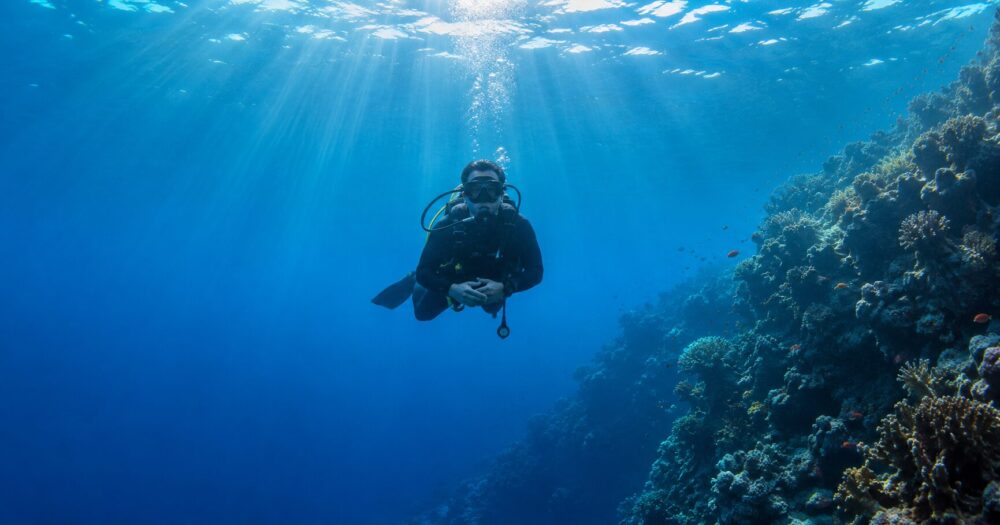
A good diving holiday depends on perfect lighting conditions underwater – whether it’s a night dive at the house reef in Dahab or exploring deep caves in southern Egypt. However, if you want to take your own diving torch with you, you should thoroughly research the transport regulations beforehand. Not every torch is allowed on the plane.
In this article, you will learn what you need to know about carrying diving torches in your luggage, what types of batteries are used in torches, and how to prepare for your diving trip without any stress.
Why are diving lamps considered dangerous goods?
Diving lamps usually contain powerful lithium-ion batteries. Under certain conditions, these batteries can generate heat and are therefore classified as dangerous goods by the International Air Transport Association (IATA) and the UN aviation authority ICAO. There is a risk of fire, especially if the batteries are damaged or improperly packaged, which is why strict regulations apply.
The good news: You can still take your lamp with you – if you bear a few things in mind.
These rules apply when flying with diving lamps.
The most important points at a glance:
- Remove the batteries: If possible, you must remove the battery from the torch.
- Secure contacts: Cover the battery terminals with insulating tape to prevent short circuits.
- Prefer hand luggage: Batteries under 100 Wh (watt hours) belong in hand luggage. Batteries over 100 Wh require the airline’s approval, and those over 160 Wh are prohibited.
- Secure the switch: The lamp must not be able to switch on accidentally – secure the switch (e.g. with a lock or tape).
- Pack separately: Transport the lamp and battery in separate, shock-protected containers if possible.
- Contact the airline: Some airlines require advance notification, especially for devices with built-in batteries.
These rules apply internationally and are implemented uniformly throughout Europe – including on flights to Egypt.
What kind of batteries are actually used in diving torches?
The most common types of batteries are rechargeable lithium-ion batteries in a cylindrical design. Here is a brief overview:
- 18650 (3.7 V, up to 3500 mAh): The classic choice for many standard diving torches.
- 26650 (3.7 V, up to 5000 mAh): Larger, with more endurance – ideal for longer night dives.
- 32650 (3.7 V, up to 6000 mAh): For particularly powerful lamps with a long burn time.
- 14500: Similar to AA battery, for compact models.
- CR123A: 3-volt disposable batteries, mostly used in smaller backup lamps.
By way of comparison, a battery with 3000 mAh at 3.7 V has around 11.1 Wh – well below the critical limit of 100 Wh for transport in hand luggage.
Examples of diving lamps and their battery strengths
To give you a better idea, here are some popular models with information on battery capacity:
- Bigblue AL1200NP-II: Compact all-rounder torch with 18650 battery (3400 mAh, approx. 12.6 Wh)
- OrcaTorch D710: High-performance torch with 21700 battery (5000 mAh, approx. 18.5 Wh)
- Scubapro Nova 850R: Robust model with 18650 battery (2600–3400 mAh depending on version)
- Supe V10K: Video lamp with 26650 battery (5000 mAh, 18.5 Wh)
- TillyTec Maxi uni: Modular professional model – battery size selectable depending on setup, up to 50 Wh possible
As you can see, even powerful lamps often remain well below the 100 Wh limit, which makes them easier to carry.
Packing tips for your diving torch
To ensure your equipment arrives safely at the Red Sea, here are a few tried-and-tested transport tips:
- Use padded bags or hard cases for the lamp and battery.
- Always carry batteries in your hand luggage – if possible, in special battery bags or their original packaging.
- Secure switches with cable ties, cover caps or adhesive tape.
- Take the technical specifications of the batteries (Wh, mAh, volts) with you in case any questions arise during the security check.
Our advice for Lagona Divers guests
Talk to your airline before you fly – especially if you want to take a powerful or unusual torch with you. Download or print out the specifications for your torch/batteries. That way, you’ll be on the safe side if you are asked about them at check-in or security.
By the way: our bases also offer lamps for hire for night dives – in case you prefer to leave your own at home.
👉 Book your diving holiday now: www.lagona-divers.com/en/rates-and-booking/
Do you like our information? Then subscribe to our newsletter, which is only sent out a few times a year (whenever we find the time) and can be unsubscribed from at any time: