One Touch Can Save Corals – A Lab Accident Brings New Hope
Sometimes science begins with a mishap.
Steve Palumbi, a marine scientist at Stanford University, had two pieces of coral from the same colony in a lab tank. One was healthy, the other bleached. Then one of them tipped over and touched the other.
A few weeks later, the white piece had its color back. And its health.
We divers know that white. We know how much it hurts when a reef you love suddenly turns pale. All the more reason to celebrate some good news.
Want to experience the reef yourself? Book your diving in Dahab here.
At a glance
- What: Stanford researchers find that a healthy coral fragment can heal a bleached one
- How: Direct contact, through which beneficial algae move across
- Result: Fragments in contact recovered fully within seven weeks, fragments without contact died
- The catch: No solution for whole reefs yet
- As of: October 16, 2026 (source: FOCUS online / dpa)
What happens during coral bleaching
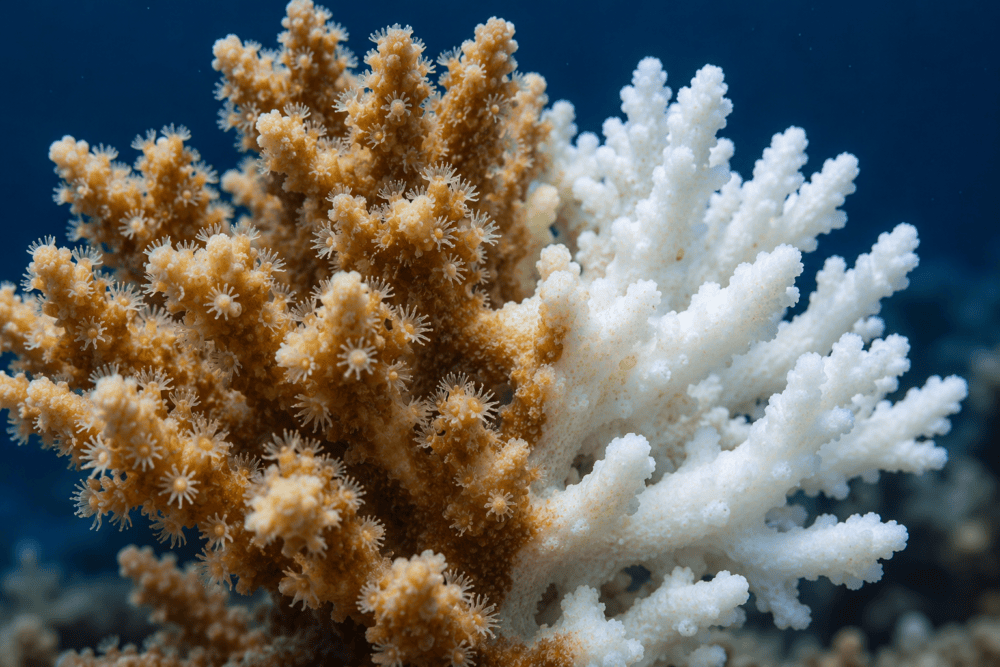
Stony corals live in partnership with tiny algae, and both sides benefit. Under stress, corals expel these algae and lose their color. Their white limestone skeleton then shows through the tissue.
Experts name human-caused climate change as the main driver of mass bleaching events worldwide.
A bleached coral is not automatically dead, though. If temperatures drop in time, it can take up new algae and recover.
The experiment: ten pairs, two distances
Palumbi’s team wanted to get to the bottom of the accident. They formed ten pairs, each made up of one healthy and one bleached fragment. In half of the pairs the pieces touched directly, in the other half a gap of just a few millimeters remained.
The result was clear:
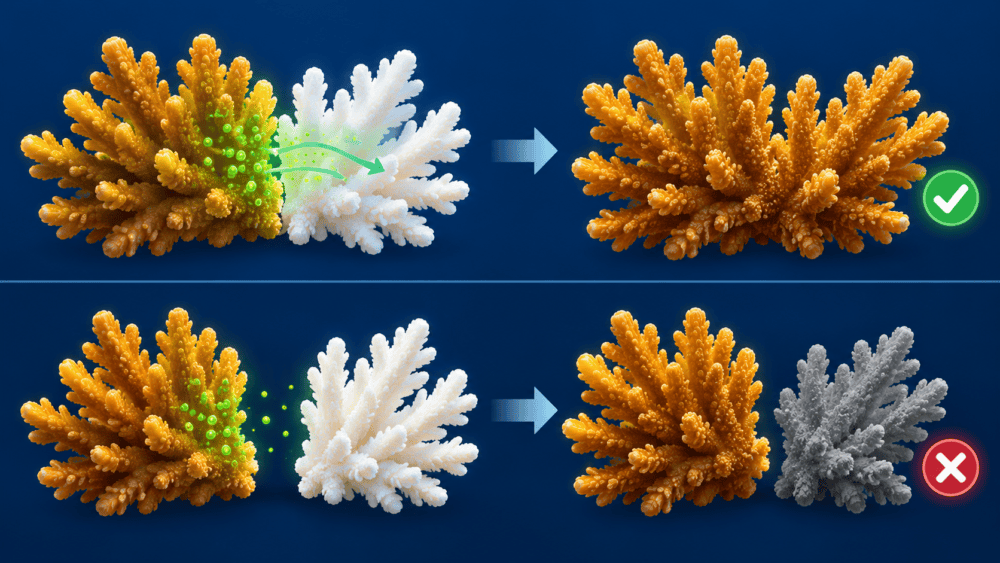
- Bleached pieces in contact with a healthy one recovered fully within seven weeks.
- Bleached pieces without contact died.
Under the microscope, the researchers saw fine channels in the tissue connecting the fragments.
Why it works: clones recognize each other
Genetically identical corals recognize each other on contact, and their tissues fuse. Palumbi compares it to organ transplants between identical twins. Through this connection, the beneficial algae travel from the healthy coral to the ailing one.
Research had not expected the algae to move that quickly and multiply in their new home. Palumbi told the “New York Times” this was the big surprise.
After about a week of contact, in some cases after only five days, the corals had apparently taken up enough algae to recover on their own.
Know your corals, dive with new eyes
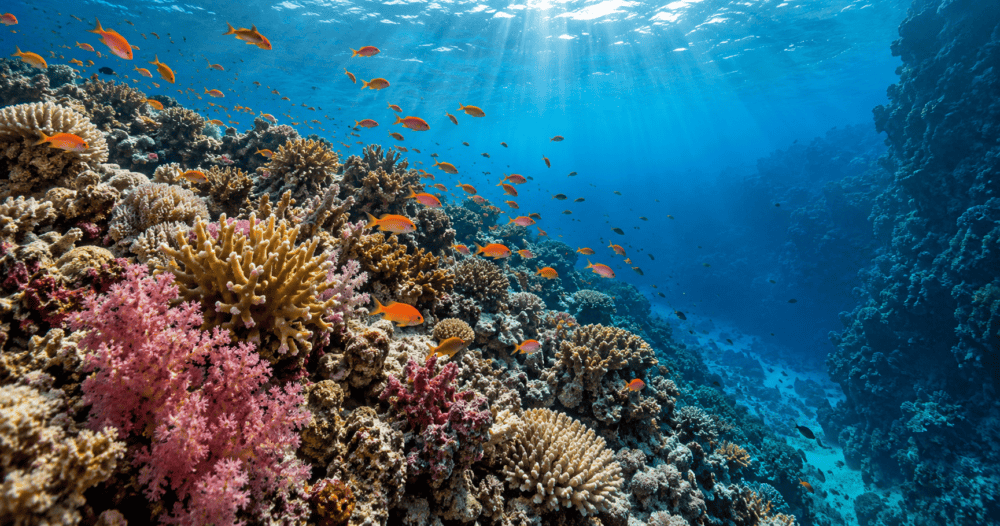
The reef is full of life. The more you know about the corals growing there, the more you see on every dive.
That is exactly what the SSI Coral Identification Specialty Diver course is for. You learn to identify the most important coral species, find out why the oceans matter so much to all of us, and discover what you can do with a few simple steps to protect them. At the end, you receive your certification.
The best part: you need no prior experience and no certification. With 7 theory units, the course takes about 3 to 6 hours. Take a look at the course here.
Tip: if you book the course in advance, our instructors will be ready for you on your first day.
The catch: no solution for whole reefs yet
Let’s be honest. For the bleaching that has already happened, the finding offers no solution yet. Every bleached coral would need a healthy, genetically identical copy. According to the study, this cannot be done on a large scale, not least because many corals have already died.
The team now wants to investigate whether algae can also be introduced without constant contact.
Why it still gives us courage
Because it shows that reefs may have more power to heal themselves than we thought. Palumbi sees reason for hope that the mechanisms discovered will prove useful.
And because every piece of good news reminds us why we dive: for living, colorful reefs.
We look with our eyes only
A small note from us, without any wagging finger: the touch in the lab was a controlled experiment. When diving, our hands stay with us, our fins stay up and our buoyancy stays under control.
Conclusion
A coral piece that tipped over, seven weeks of patience and an insight that gives hope. The reef is more resilient than we sometimes fear, but it needs us as mindful guests.
Ready to plan your reef experience? Book your diving in Dahab – and if you do not want to miss any news from the reef, subscribe to our newsletter.
See you underwater.
Frequently asked questions
What is coral bleaching?
The coral loses its algae and with them its color. It is weakened, but not dead right away.
Can a bleached coral recover?
Yes, if temperatures drop in time and it takes up algae again.
Does this finding save our reefs?
Not yet. So far, the method cannot be used on a large scale.
May I touch corals to help?
No, please don’t. This was a controlled lab experiment.
What do I learn in the Coral Identification Specialty?
You learn to identify the most important coral species, why the oceans matter, which threats they face and how you can help.
Do I need prior experience?
No. There are no certification requirements. The course consists of 7 theory units (3–6 hours recommended).
Never miss reef news
Want more from us, never miss news from Dahab and get a regular dose of the Red Sea in your inbox? Then subscribe to our newsletter and stay up to date on stories, travel tips, offers and everything happening at Lagona Divers.